Structured decisions. Sustainable results.
The success of corporate investments does not begin at implementation, but at the preparation of the decision. The purpose of data-driven decision support is to present technical, financial, and operational aspects within a coordinated, interpretable framework.
Transparency is a prerequisite for optimal decision-making
The quality of an investment is determined not by the technology, but by the soundness of the decision behind it. Whether it concerns an energy development, a financing structure, or an operational transformation: an optimal solution can only emerge when the decision is backed by structured, interpreted data.
A decision can be made on the basis of intuition or partial information — but a truly well-founded, business-optimized decision can only be reached through the analysis of the complete system of interrelationships.
At DVX, therefore, the foundation of every project is data collection and the uncovering of business interrelationships: a concrete recommendation is only worth formulating once built upon this.
Why is intuition not sufficient?
An investment decision is not merely a capital expenditure, but a long-term corporate impact: on operations, liquidity, financing, and flexibility alike.
It is common for decisions to be made on the basis of a single metric. The true business picture, however, only comes together when the interrelationships between energy prices, consumption profiles, financing conditions, and the regulatory environment are also visible.
Intuition can provide direction — but sound decision-making requires structured analysis.
What does data-driven decision-making mean in practice?
The goal is not more data, but a better decision-making position.
Scenario-based modelling
We do not prepare a single calculation, but compare multiple possible business outcomes.
Sensitivity and variable management
We examine how returns evolve with changes in energy prices, utilization rates, or financing conditions.
Cash flow and operational impact
The investment matters not only in the long term — in the short term it also affects the company's financial stability.
Identification of risk factors
A decision is well-founded when the degree of uncertainty is also visible and manageable.
Typical corporate decision-making situations
Data-driven decision support is not a theoretical framework, but becomes relevant in concrete corporate situations. The following questions arise in almost every energy or development project.
- What investment size fits the actual consumption and operational profile?
- How does a grant scheme affect the overall financial trajectory of the project?
- Does own capital or financing provide more predictable liquidity?
- When is it justified to proceed with the development in light of the market and regulatory environment?
These questions are not technical in nature, but corporate decisions. DVX's role is to organise the technical, financial, and operational aspects into a common decision-making space, prior to the implementation phase.
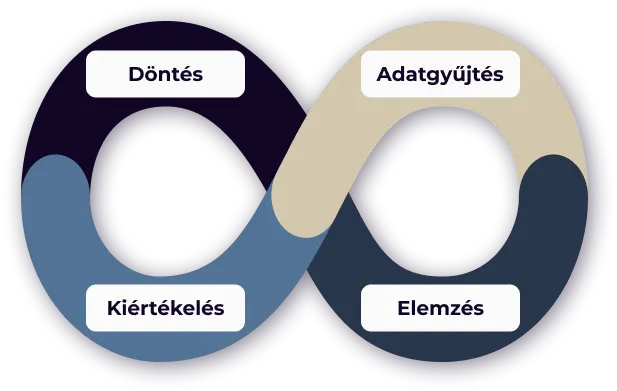
The process of data-driven decision-making
A decision is not a conclusion, but part of a cycle. Feeding back the results measured during implementation helps refine the next steps, which is why developments often progress in smaller, controlled increments.
The success of investments is determined not by technology, but by the quality of decisions. DVX supports its partners within this framework: the goal is not merely implementation, but a decision that is defensible at corporate level and economically well-founded.
Professional consultation on digitalization matters
Should any questions arise regarding operational optimization or data-driven decision support at your company, we are happy to assist through a structured professional consultation.